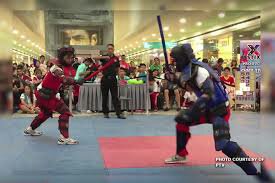
HISTORY OF ARNIS
Arnis is otherwise known as eskrima, kali and garrote, and by even more names in different Filipino regional languages. Although Spanish influence had a pacifying effect on Filipino martial culture, the original warrior ethos has persisted and remains on the fringes of the art. Arnis “death-matches” were outlawed atraditions 1945 yet, as Mark V. Wiley explains in Filipino Martial Culture, they still take place in private today.
Over the years, Arnis has become more than just another form of martial arts. It became a crucial part of the Filipino culture, taking its place as a practice that has changed the face of history on so many occasions.
As of 2009, the National Congress of the Philippines declared that Arnis is the national sport and martial art of the Philippines. It promotes nationalism, patriotism and paying tribute to the ancient and mighty heroes who have done so much for their country. Nobody can forget how these warriors fought against the Spanish invasion using only their swords, bodies and will power in order to grant their country its freedom.
HOW TO PLAY ARNIS?
When you play an arnis it is important to know that there are two types of arnis sport. The first type is anyo or a form and the laban or full combat competitors.
Anyo or a form the player use one or two batons. In this form we should put a gracefulness & strength to do this properly.
Then the full combat competition we need to strike the different parts of the body of our competitors but we only use one baton.
In playing arnis we need the ability to move quickly and we should keep our eye on the competitors. Always remember focus on the play that you are doing so you will get a high score and you will protect yourself in this type of competition.

RULES AND REGULATION
ARNIS COMPETITION RULES
Padded Point Rules
• Opponents will begin and end all matches with a salute or bow to each other and the judges.
• Referee will position fighters beyond largo range at the start of every round.
•Each match has a best of three rounds.
• Hits, slashes, and witticks are all legal. Punots, pokes and stabs are all illegal.
• In single stick competition, it is NOT legal to block a stick with your free hand. However, “arm stopping” at quarto range or arm checking is allowed.
• Fighters are required to exhibit a realistic defense (movement, parrying, intelligent blocking…)
• No takedowns. No grappling, wrestling or hooking.
• No pushing or striking with any part of your body.
• No foot sweeps or throws, thrusting or butt strikes, 2 handed strikes.
•A player can win if the opponents commit three fouls.
•In case of a tie. The first player who hit the opponent is the winner.
• To signal surrender or stop action for an injury, equipment failure, etc., raise both hands and back up. Do not turn away.
Live Stick Rules
• Opponents will begin and end all matches with a salute or bow to each other and the judges.
• Referee will position fighters beyond largo range at the start of every round.
•Each match has a best of three rounds.
• Fighters are required to exhibit a realistic defense (movement, parrying, intelligent blocking…)
• No strikes or kicks below the waistline or direct strikes to the back.
• No kicks below the waist or above the neck.
• No knee strikes or elbow strikes.
• Checks may be used to create distance but may NOT be directed to the face. Checks are allowed below the neck and above the waist free hand or two hands on weapon (AKA rifle checking).
• Trapping and parrying are allowed. Locking and holding are not.
• An instantaneous “Hold and Hit” with immediate release is allowed.
• In the event inaction or ineffective action in the clinch, referee will call time and break clinch.
• Disarms must be immediate, or have an immediate release (1 – 2 rule applies).
• Joints may not be locked or twisted for a disarm.
• You may use the ring to control the action. You may not use it to avoid action.
• To signal surrender or stop action for an injury, equipment failure, etc., raise both hands and back up. Do not turn away.
JUDGING, SCORING & OFFICIATING
All matches scored by 3 judges on the “10 Point Must” system prior to deductions. Deductions will be issued by referee only. Judges may issue bonus points for exemplary technique. Referee will ID rule infractions, issue warnings and mandatory point deductions. Scoring is based on: Quantity of strikes, Effectiveness of Striking and Ring Generalship.
In single stick competition, disarms shall be scored as part of the match as a mandatory point deduction. 3 disarms will result in a TKO. The 3 disarm rule may be waived at the tournament directors discretion.
EQUIPMENTS
•Padded Stick
•Live Stick
•Head Gear
•Body Gear
•Forearm and Shin Guards
•Groin Guard
•Upper and Lower Leg Guard
•Hand Gloves
BASIC STRIKES IN ARNIS
#1 – Left side of the head attack
#2 – Right side of the head attack
#3 – Left side of the body or torso
#4 – Right side of the body or torso
#5 – Thrust To The Stomach
#6 – Left Chest Stab
#7 – Right Chest Stab
#8 – Left Lower Leg
#9 – Right Lower Leg
#10 – Left Eye Poke
#11 – Right Eye Poke
#12 – Strike to the crown/top of head.

 babablog.com